
What Should Your Kid Be When They Grow Up? Not a CEO.
Anthropic's new labor market report reveals which jobs AI is actually coming for — and they're not the ones you'd expect parents to worry about.
What Should Your Kid Be When They Grow Up? Not a CEO.
My daughter asked me the other day what she should be when she grows up. I almost said "anything you want, sweetie" — but then I looked at this chart.
Yesterday, Anthropic published their labor market impact report — and it's one of the most honest, data-driven pieces I've read on AI and jobs. No hype. No fearmongering. Just a radar chart that quietly says more than a thousand LinkedIn hot takes.
Look at the Blue
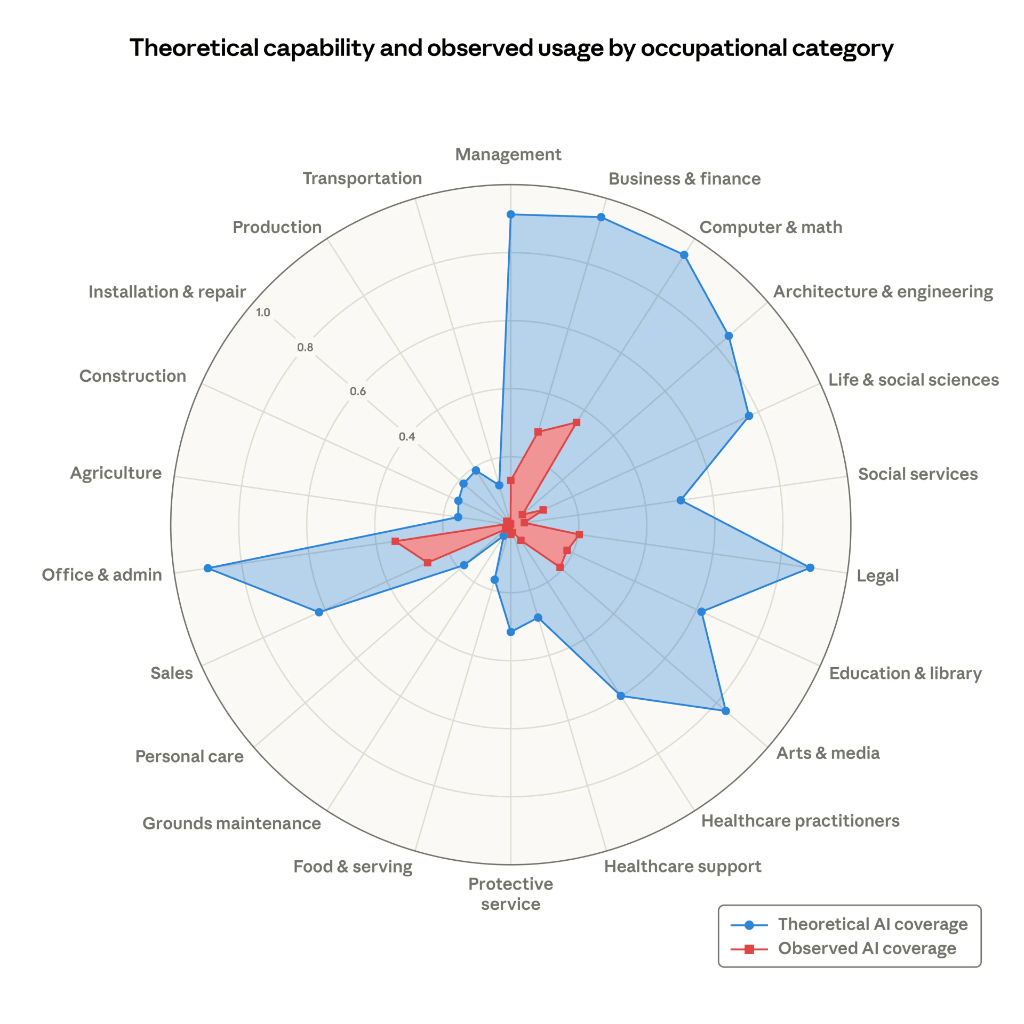
The blue area is theoretical AI coverage — what AI could do for each occupation category. The red is what it actually does today.
Now look at where the blue spikes hardest:
- Management
- Business & Finance
- Computer & Math
- Legal
- Architecture & Engineering
These are the "fancy" careers. The ones parents push their kids toward. The ones guidance counselors put on the whiteboard. The ones that come with corner offices and LinkedIn headlines.
Now Look at What's Safe
The occupations where AI barely registers?
- Construction
- Grounds maintenance
- Food & serving
- Personal care
- Installation & repair
The hands. The body. The work that requires you to be there, physically, in the real world.
The irony: the careers society considers "lesser" are exactly the ones AI can't touch. The prestigious ones? Those are the bullseye.
The Gap Is a Ticking Clock
Here's the part that keeps me up at night: the gap between blue and red. AI can already do most of the tasks in management, finance, and law — it just hasn't yet. That red area is going to expand. Fast.
Anthropic's data confirms this isn't just theory — hiring of workers aged 22–25 in exposed occupations has already slowed by 14% since ChatGPT launched. Not because people are being fired. Because companies aren't hiring the next generation for these roles.
So What Do You Tell Your Kid?
I'm not saying tell your child to skip university. But maybe don't tell them a law degree or an MBA is a guaranteed ticket anymore.
Maybe tell them to learn how to build something with their hands and use AI as a power tool. The plumber who can prompt an AI to optimize scheduling. The nurse who pairs clinical instinct with an AI diagnostic assistant. The electrician who uses computer vision to inspect wiring.
The future belongs to people who can do what AI can't — and use AI for everything else.
So what would you tell your kid?
Source: Anthropic — Labor Market Impacts of AI: A New Measure and Early Evidence (March 2026)
More writing from the archive
Jev Is Not a Chatbot: Build AI Decisions Into Your Product
Jev is not a cheaper chatbot but a structured decision engine. Use batching, confidence thresholds, and clear system boundaries to build with it.
Tool Access Is Not Interaction Agreement
Agent tools can authorize and verify every step while still delivering the wrong outcome. The missing layer is an agreement about what done means.
Projects connected to this thinking
Open Brain: Building a Personal Knowledge Backend with AI
Open Brain: Building a Personal Knowledge Backend with AI What if your notes could think? Not in a sci fi way — but in a practical, "I wrote something three months ago th…
Raiffeisen Bank: End-to-End Online Account Opening
Raiffeisen Bank: End to End Online Account Opening When Raiffeisen Bank decided to let customers open a bank account entirely online — no branch visit required — they kne…