
Raiffeisen Bank: End-to-End Online Account Opening
How we designed a fully digital bank account opening experience from discovery research to UI — using co-creation workshops to align 7 departments in 10 weeks.
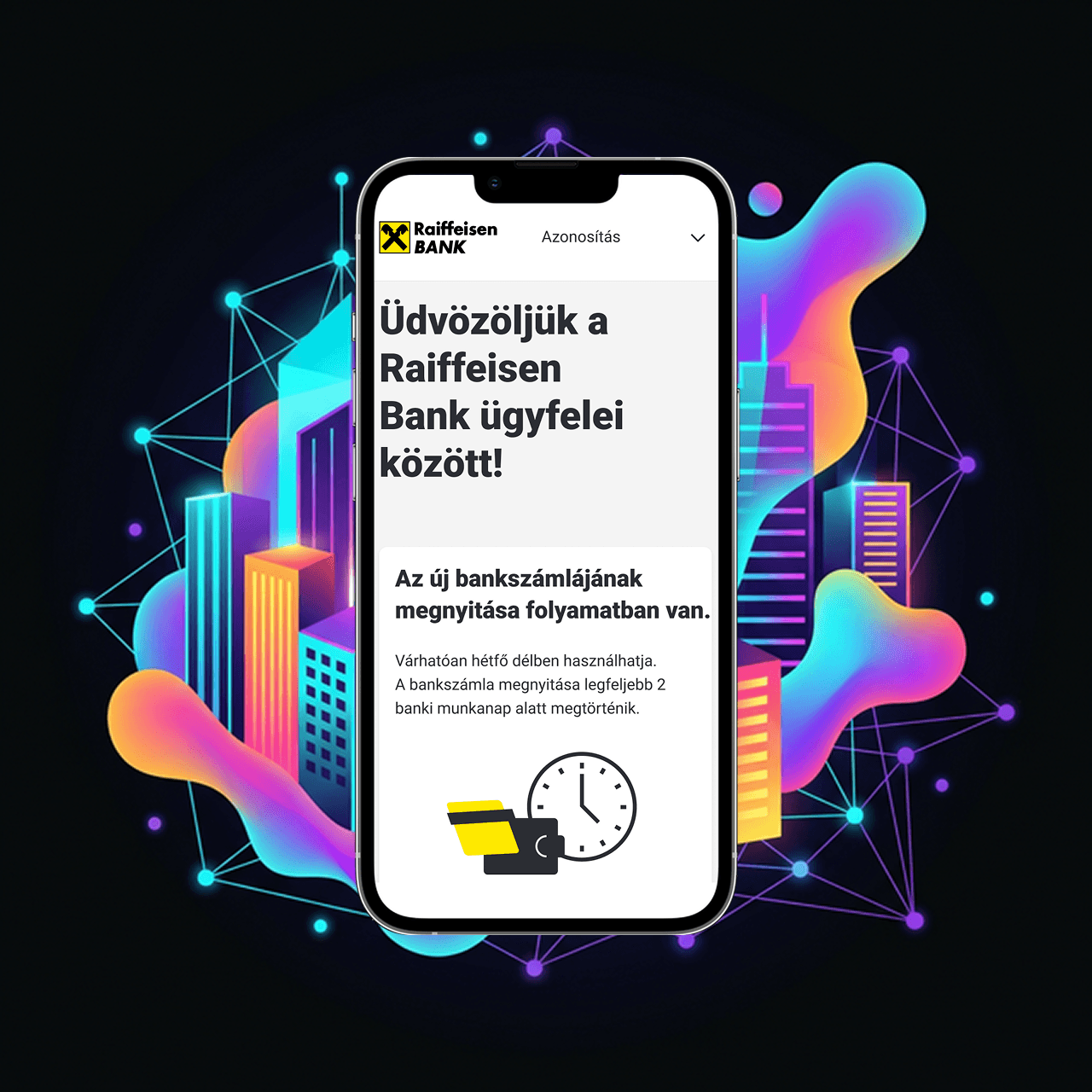
Raiffeisen Bank: End-to-End Online Account Opening
When Raiffeisen Bank decided to let customers open a bank account entirely online — no branch visit required — they knew the interface was only half the challenge. The harder part was getting Legal, Marketing, IT Architecture, and Customer Experience to agree on what that experience should look like.
The Challenge
Raiffeisen's goals were clear: build a fully digital account opening flow, reuse existing backend systems to minimize development effort, and introduce their new group-wide design system — RBI-DS — to the Hungarian market.
What they didn't account for was how many opinions existed across the organization.
The real complexity wasn't the UX. Seven departments — Legal, Marketing, Project Management, Product Development, IT Business Analysis, IT Architecture, and Customer Experience — each had their own requirements, constraints, and veto power.
Before designing a single screen, we needed to get everyone in the room and working toward the same goal.
The Solution
It was early 2020. COVID restrictions were shutting down bank branches across Hungary, and Raiffeisen needed a fully digital account opening flow — fast. The technical lift was straightforward. The organizational challenge was not: seven departments, each with conflicting requirements and effective veto power, had to converge on a single experience.
In a standard enterprise process, that setup produces months of back-and-forth and a product nobody loves but everyone has signed off on. We took a different path — a structured UX journey through discovery research, co-creation workshops, iterative design, and user-tested delivery, all compressed into a 10-week timeline.
Here's how it came together.
Discovery: Understanding the Landscape
We opened with a structured discovery phase to map both the problem space and the competitive context:
- Kickoff workshop — an Elevator Pitch exercise to align business requirements and strategic intent across stakeholders
- Competitor analysis — audited the account opening flows of 3 domestic competitor banks to identify friction points and benchmarks
- Best practice research — studied how challenger neobanks (with fewer legacy constraints) handle the same journey
- User interviews — surfaced real pain points from customers who had recently opened accounts at competitor banks
This gave us a clear picture: most existing flows required too many steps, too many document uploads, and zero feedback on progress. Users abandoned mid-flow and didn't know why.
Define: Co-creation Over Presentation
Rather than presenting a solution, I ran 3 half-day workshops with representatives from all seven departments. The format combined structured facilitation with collaborative design methods:
- Built personas together, so every department had ownership over the users we were designing for
- Mapped the ideal user journey as a group, surfacing conflicts between what Legal required and what CX wanted early — before they became expensive problems in development
- Used Design Studio to sketch non-existing screens collaboratively, embedding new touchpoints into the existing frontend structure
Getting stakeholders to sketch together — even badly — changes how they engage with design decisions later. They stop critiquing and start co-owning.
The workshops delivered something beyond alignment: they gave us a validated screenflow before we'd written a single specification.
Develop: Wireframes to High-Fidelity UI
With the flow agreed, we moved into 3 iterations of wireframe refinement. Each round was reviewed with the core project team, with Legal and Compliance signing off on copy and flow logic at defined checkpoints.
Once wireframes were stable, we built the UI directly within RBI-DS — Raiffeisen Bank International's new design system. This meant:
- Working within a structured component library to ensure consistency across the Hungarian and other regional rollouts
- Collaborating with IT on constraints specific to the existing frontend architecture
- Aligning every component decision with the design system's token structure
The team was three designers: Balázs Dömsödi, Kristóf Munkácsi, and myself.
Deliver: Testing and Validation
With the UI complete, we built a clickable prototype and ran usability testing with real users recruited from Raiffeisen's target segments.
Testing focused on:
- Task completion rate through the full account opening flow
- Drop-off points and comprehension issues with form fields and instructions
- Trust signals — did users feel confident entering personal and financial information?
Findings fed directly into a final round of improvements before handoff to development.
Outcomes
// in the five years since launch
// in usability testing
Digital
Flow.
// shipped end-to-end
// within the 10-week timeline
// introduced to the hungarian market
// reducing extensive rework risk
The account opening flow is live at szamlanekem.raiffeisen.hu — a product that shipped on time because we invested in alignment before design.
Lessons Learned
Getting everyone on board is not a soft skill — it is a design problem.
Co-creation workshops only work when they serve a clear purpose. I've seen workshops run "for the sake of inclusion" that generate noise rather than signal. The key is to structure them around real decisions: What is the user journey? Which screens need to exist? What are the hard constraints?
When you answer those questions together, you don't just get alignment — you get commitment. Stakeholders who helped design the solution don't pick it apart in review.
I've since applied this approach on every complex project I've led. It works especially well in enterprise environments where the organizational complexity rivals the design complexity.
Continue exploring project work
Open Brain: Building a Personal Knowledge Backend with AI
How I built a vault-first personal knowledge system using AI tools, Obsidian, and open-source components — where every piece is swappable.
Read the thinking behind the work
WebMCP and the New Language of the Invisible Web
WebMCP and the New Language of the Invisible Web We designed the web for humans. For eyes, hands, mice, touchscreens. Buttons, menus, calendar widgets, cart flows, checko…
Google I/O 2026: Vibe Coding, WebMCP and Invisible Commerce
How Google is reshaping AI agents, web development and the future of commerce. At first glance, the Google I/O 2026 keynote looked similar to recent AI announcements: new…
Need this level of clarity for your own product or AI initiative?
If this case study feels close to your challenge, send a brief and I can help define the right next move.