
Why AI Agents Still Need Human Agency
AI Agents are fast, but real work depends on intent, context, judgment, and accountability. That is still a human role.
Why AI Agents Still Need Human Agency
Most AI conversations go wrong at the same point: teams confuse speed with autonomy.
An AI Agent can move very fast. It can inspect files, call tools, draft content, break down tickets, query systems, and propose structure. Work that used to take half a day can sometimes be prepared in minutes.
Then it stops.
It waits for the next instruction. The next constraint. The next human decision.
That quiet moment matters more than the demo.
OpenAI's agent documentation describes systems built from models, tools, instructions, handoffs, and guardrails. Anthropic's Claude Skills point in the same practical direction: reusable instructions and resources for specific tasks. Microsoft's guidance on agentic workflows also focuses on controlled processes, clear outcomes, accountability, and human oversight.
The point is simple: AI Agents are strong executors. Direction, judgment, and responsibility still come from people.
Achilles Runs, the Tortoise Sets Direction
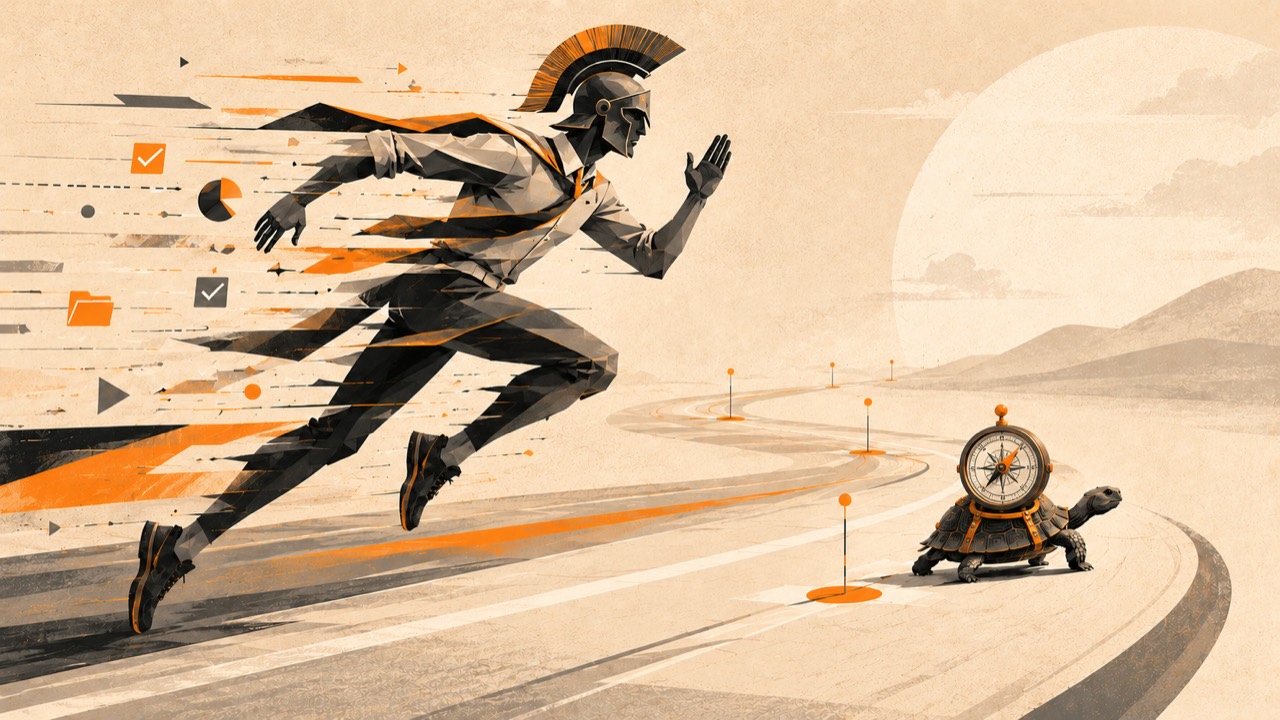
Zeno's paradox of Achilles and the tortoise is a useful metaphor for AI workflows.
Achilles is much faster than the tortoise. But if the tortoise gets a head start, Achilles first has to reach the point where the tortoise began. By then, the tortoise has moved forward. Achilles closes the gap again. The tortoise moves again. The distance shrinks, while the target keeps shifting.
The agent is Achilles. It sprints.
The human is the tortoise. It carries context.
A product decision is more than task execution. It is a judgment about tradeoffs, timing, priority, and risk.
A UX direction is more than a generated artifact. It is a bet on how people will think, hesitate, trust, fail, or recover.
A service design workflow is more than a sequence of steps. It contains operations, internal politics, customer support pressure, legal risk, brand judgment, sales promises, and real customer frustration.
The agent can prepare many of these materials. You still decide which parts matter.
Fast output can look like product judgment. It is still output. Someone has to carry the weight of the decision.
Agent and Agency Are Different Things
The wording creates part of the confusion.
An agent acts on behalf of someone else. In software, an AI Agent is usually a model-based system that chooses next steps inside a designed environment of tools, instructions, memory, handoffs, and guardrails.
Agency is a more human word. It means the ability to act and choose a course of action. In practice, it includes motivation, taste, curiosity, responsibility, refusal, and the instinct to challenge the brief.
A customer support agent can draft a reply. The company decides how it wants to behave when a customer is angry.
A research agent can cluster interview notes. A human team decides which insight should change the roadmap.
A coding agent can implement a ticket. The product consequence belongs to the team.
AI Agents add capacity. Human agency gives that capacity direction.
Three Patterns Worth Taking Seriously
1. Every Sprint Ends With a Question
Start a good agent and the speed can feel alarming.
It reads context, runs through subtasks, prepares a draft, and compresses hours of work into minutes. In the demo moment, it can feel as if the work has disappeared.
Then it hands the work back.
Is it useful? Is it accurate? Was the premise right? Does it fit the situation? Is it bold enough? Is it careful enough? Can it go to a client? Is this even the right thing to spend time on?
Token prediction does not answer those questions.
IBM explains LLM generation as producing text token by token based on learned statistical relationships. With tools, context, and strong instructions, that can create powerful behavior. It still does not create durable intent.
A model can continue a process. You give the process meaning.
2. Yesterday's Competence Gets Cheaper
A lot of AI output feels impressive because it makes yesterday's expertise cheap.
First drafts, summaries, routine analysis, QA passes, ticket breakdowns, classification, boilerplate strategy documents. Agents can create real value here.
The next problem starts immediately: the organization receives a flood of "almost good" material.
Almost good briefs. Almost good research summaries. Almost good landing copy. Almost good backlogs. Almost good service blueprints.
"Almost good" becomes a review problem. Someone has to decide what deserves attention, what should be deleted, what should be combined, and where the missing thought still needs to be added.
As generation gets cheaper, taste, framing, prioritization, and product judgment become more valuable.
3. Distance Increases Entropy
The further an agent gets from human review, the easier the work drifts.
The prompt rarely contains the full reality. The backlog ticket does not. The tool schema does not. The company wiki certainly does not.
Real work is full of half-spoken rules: which customer is sensitive, where the security risk sits, what the brand can tolerate, which internal process will break after a bad decision.
This is why agent-building guidance emphasizes guardrails, escalation points, and human oversight, especially for early deployments, failure thresholds, and high-risk actions.
A strong agent workflow knows where the system can move quickly, where review is required, and where the agent should stop immediately.
Good agent architecture is about timing: when the agent runs, when it asks, and when it stops.
What Product Teams Should Do With This
If your team is panicking about AI, bring the conversation back to the workflow.
Where does the work need speed? Give that part to the agent.
Where does the work need synthesis? Let the agent prepare the material and keep human review close.
Where does the work carry reputational, legal, customer experience, or business risk? Keep the decision clearly owned by people.
This is the practical foundation of useful AI strategy: better instructions, better tool connections, better guardrails, better review loops. Less magic. More operational discipline.
The tortoise stays in the race because it knows where the race should go.
For teams trying to turn AI experiments into working workflows, the next step is rarely another doom essay. The useful work is agent architecture, clear responsibility, and a system that makes humans faster while keeping judgment in human hands.
If you and your team want to build a real, working workflow where humans and AI agents complement each other well, the next step is usually not another prompt collection, but dedicated AI Product Strategy consulting.
Sources
More writing from the archive
Open Knowledge Format: A Shared Language for AI Agents
OKF shows why stronger models are not enough: AI agents need shared, portable context that humans can still read.
Google I/O 2026: Gemini 3.5 Flash and the Agent Era
Google I/O 2026 was less about flashy demos and more about a real platform shift: faster models, managed agents and AI systems that can actually act.
Projects connected to this thinking
Open Brain: Building a Personal Knowledge Backend with AI
Open Brain: Building a Personal Knowledge Backend with AI What if your notes could think? Not in a sci fi way — but in a practical, "I wrote something three months ago th…
Raiffeisen Bank: End-to-End Online Account Opening
Raiffeisen Bank: End to End Online Account Opening When Raiffeisen Bank decided to let customers open a bank account entirely online — no branch visit required — they kne…