
Google I/O 2026: Gemini 3.5 Flash and the Agent Era
Google I/O 2026 was less about flashy demos and more about a real platform shift: faster models, managed agents and AI systems that can actually act.
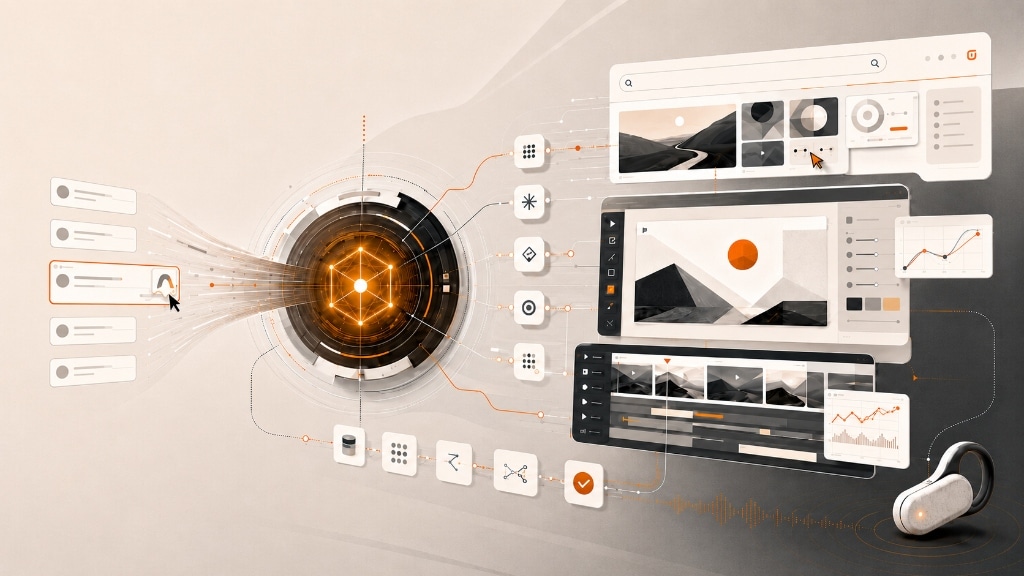
Everyone is talking about AI agents. What Google showed at I/O 2026 is what happens when those agents stop being a feature and start becoming infrastructure.
You could split yesterday’s announcements into a dozen separate articles. But the useful reading is simpler than that. The real story is not one model, one app or one demo. It is the stack. Google is assembling a system where models, agent harnesses, search, creative tools and ambient interfaces all point in the same direction: from prompts to action.
That matters because most AI products still live in the assistant phase. They can answer, summarize and suggest. Fewer can reliably do work across tools, preserve context, run in the background and return something usable. Google’s I/O message was that this is now the bar.
Gemini 3.5 Flash is the engine, not the whole car
The headline launch was Gemini 3.5 Flash, the first release in Google’s 3.5 family. According to Google, it outperforms Gemini 3.1 Pro on several coding and agent benchmarks and runs at roughly 4x the output speed of other frontier models. That is not a small detail. In agent workflows, speed is not cosmetic. It changes whether the interaction feels like a product or a waiting room.
What makes 3.5 Flash interesting is not just raw model quality. It is the positioning. Google is framing it as a model for long-horizon agentic tasks, coding, reasoning across tools and producing richer interactive interfaces. In other words, this is less about chat and more about execution.
Faster output alone does not make an agent useful. Faster output inside a well-designed execution environment does.
I couldn't wait and immediately tried Gemini 3.5 Flash inside Antigravity 2.0. I didn't see the promised speed in input processing and reasoning yet, but when it came to generating results, it happened with devilish speed. It performed the assigned coding task with great care and proactively suggested an implementation method that it was not explicitly instructed to do, but which made the solution much more future-proof.
Antigravity 2.0 is the bigger signal
The bigger announcement, in my view, was Antigravity 2.0.
Google describes it as a new standalone desktop app built around an agent-optimized experience. That phrasing matters. This is not a chatbot window with a few new buttons. It is meant to be a home for orchestrating multiple agents, parallel work, subagents, scheduled tasks and stateful execution. Google also tied the same harness to managed agents in the Gemini API and to Google AI Studio.
That is the architectural shift.
For the last two years, a lot of “AI product design” has really meant wrapping a model in a text box and hoping the prompt does the heavy lifting. Antigravity suggests a different future: agents with their own runtime, their own task structure and their own persistence model. Once that layer exists, agents stop feeling like a novelty and start behaving more like software operators.
That is also why the developer announcements matter beyond developers. When Google says managed agents can reason, use tools and execute code in isolated environments, it is describing the foundation for more serious products, not just better demos.
The designer story is just as important
The coding crowd will understandably fixate on Antigravity, CLI workflows and agent orchestration. But some of the most consequential changes are on the creative side, because they affect how visual work gets produced, edited and operationalized.
Google Pics is Google’s new image creation and editing tool in the Workspace ecosystem. The interesting part is not just image generation. It is the promise of precise control: object-level editing, direct text editing inside images, Workspace integrations and collaborative canvases. That moves the conversation away from “generate something interesting” and toward “make the exact change I need without rebuilding the asset.”
Then there is Gemini Omni inside Google Flow. Google positions Omni as a model that can create from any input, starting with video, and edit naturally through conversational language. The practical implication is huge. If identity, scene logic and motion can be preserved while the environment, composition or edit intent changes, the tool becomes much more usable for real production work.
Flow Tools may be even more strategically important. Google is effectively saying creatives should be able to generate their own bespoke tools and workflows with natural language. That is a serious idea. It shifts creative software from a fixed interface to a configurable one, shaped by the task instead of only by the vendor roadmap.
Teams that still treat AI as a one-off content generator are going to miss the bigger change: AI is becoming workflow infrastructure.
Search, Spark and eyewear show where this is going
The rest of the announcements reinforce the same pattern.
Search is getting information agents that monitor topics in the background and return synthesized updates. Google also said Search will use Antigravity-backed capabilities to assemble dynamic interfaces, interactive visuals and task-specific mini-apps. That is not just better retrieval. It is search turning into an execution surface.
Gemini Spark pushes the same logic into personal productivity. It is designed as a 24/7 agent that works across your digital life under your direction, with Workspace integrations and background task handling. Whether users will trust it at scale is another question. But strategically, the direction is obvious: persistent agents, not just reactive assistants.
And then there is the hardware angle. Google’s first audio glasses are due this fall, with Gemini available through a discreet audio interface. That matters because it extends the agent model beyond screens. If the software layer is persistent enough, ambient enough and useful enough, it no longer needs to wait for you to open an app.
The takeaway
The most important thing Google announced at I/O 2026 was not a single feature. It was a design philosophy.
The company is building toward a world where AI is not a tool you occasionally consult, but an operational layer that can plan, monitor, build, edit and act across contexts. Gemini 3.5 Flash gives that system speed. Antigravity 2.0 gives it a runtime. Search agents, Spark, Pics, Omni and Flow Tools show how that runtime spreads into work, media and everyday interfaces.
The practical takeaway is simple: if you are designing digital products right now, stop thinking only in terms of prompts and outputs. Start thinking in terms of agent environments, execution boundaries, trust, review loops and where background work should live.
That is where the real competition is moving.
More writing from the archive
Why AI Agents Still Need Human Agency
AI Agents are fast, but real work depends on intent, context, judgment, and accountability. That is still a human role.
9 Months of Customizing Claude Code: What I Built and Why
How I turned Claude Code from a default AI assistant into a personalized workflow — 9 skills, 55 plugins, daily routines, and the philosophy behind it all.
Projects connected to this thinking
Open Brain: Building a Personal Knowledge Backend with AI
Open Brain: Building a Personal Knowledge Backend with AI What if your notes could think? Not in a sci fi way — but in a practical, "I wrote something three months ago th…
Raiffeisen Bank: End-to-End Online Account Opening
Raiffeisen Bank: End to End Online Account Opening When Raiffeisen Bank decided to let customers open a bank account entirely online — no branch visit required — they kne…