
Google I/O 2026: Vibe Coding, WebMCP and Invisible Commerce
How Google is reshaping AI agents, web development and the future of commerce.
How Google is reshaping AI agents, web development and the future of commerce.
At first glance, the Google I/O 2026 keynote looked similar to recent AI announcements: new models, faster responses, smarter assistants and more automation.
But behind the "frontier model" hype, something much more important is emerging.
Google is not just shipping new AI features. It is building a completely new digital infrastructure.
This infrastructure could fundamentally reshape:
- how websites are built,
- how mobile apps are developed,
- how e-commerce works,
- and how software systems communicate with each other.
The real question is no longer "what can this model do?" but:
how do we design products, interfaces and services for a world where systems are used not only by humans, but also by autonomous agents?
A new layer of the web: WebMCP and the agent-compatible internet
One of the most important - and perhaps least flashy - announcements was WebMCP (Machine Client Protocol).
Today's web was designed for humans. Buttons, menus, forms and checkout flows are built around visual interaction and manual navigation.
Until now, AI agents have essentially been trying to use the internet "blindfolded."
They analyzed DOM structures. They parsed accessibility trees. They tried to guess what buttons and flows were meant to do.
WebMCP changes that.
The protocol allows websites to communicate with AI agents in a structured and machine-readable way.
This means agents can:
- directly invoke functions,
- access forms through understandable structures,
- reliably trigger workflows,
- and stop guessing how interfaces work.
From a UX and product design perspective, this is a major shift.
Designing good human UX will no longer be enough.
We will also need to design Agentic Experiences (AX).
The arrival of the real AI developer: Chrome DevTools for Agents
Another major announcement was Chrome DevTools for Agents.
This may sound like a technical detail, but it represents a critical step toward autonomous software development.
One of the biggest limitations of AI coding so far was that agents could not truly observe the outcome of their own work.
Now they can:
- run their own code,
- analyze errors,
- launch Lighthouse audits,
- debug issues,
- and automatically improve systems.
This is not just better autocomplete.
It is the beginning of coding agents capable of iterative self-validation and self-correction.
Vibe coding: when the prompt becomes the IDE
Google AI Studio made it clear that Google is fully embracing the "vibe coding" direction.
The idea is simple:
we no longer write code, we express intent.
During the keynote, fully native Android apps were generated from prompts in Kotlin - without local development environments.
No SDK setup. No build pipeline configuration. No manual dependency management.
AI Studio is rapidly evolving into a browser-based, AI-orchestrated development environment.
Automating iOS-to-Android migration
One of the most underrated announcements was the new migration assistant.
Android Studio will soon be able to analyze existing iOS projects and regenerate them for Android.
The demo showcased:
- storyboard analysis,
- asset conversion,
- translation of iOS-specific UI components,
- and generation of Jetpack Compose screens.
This could dramatically reduce platform development costs and accelerate scaling.
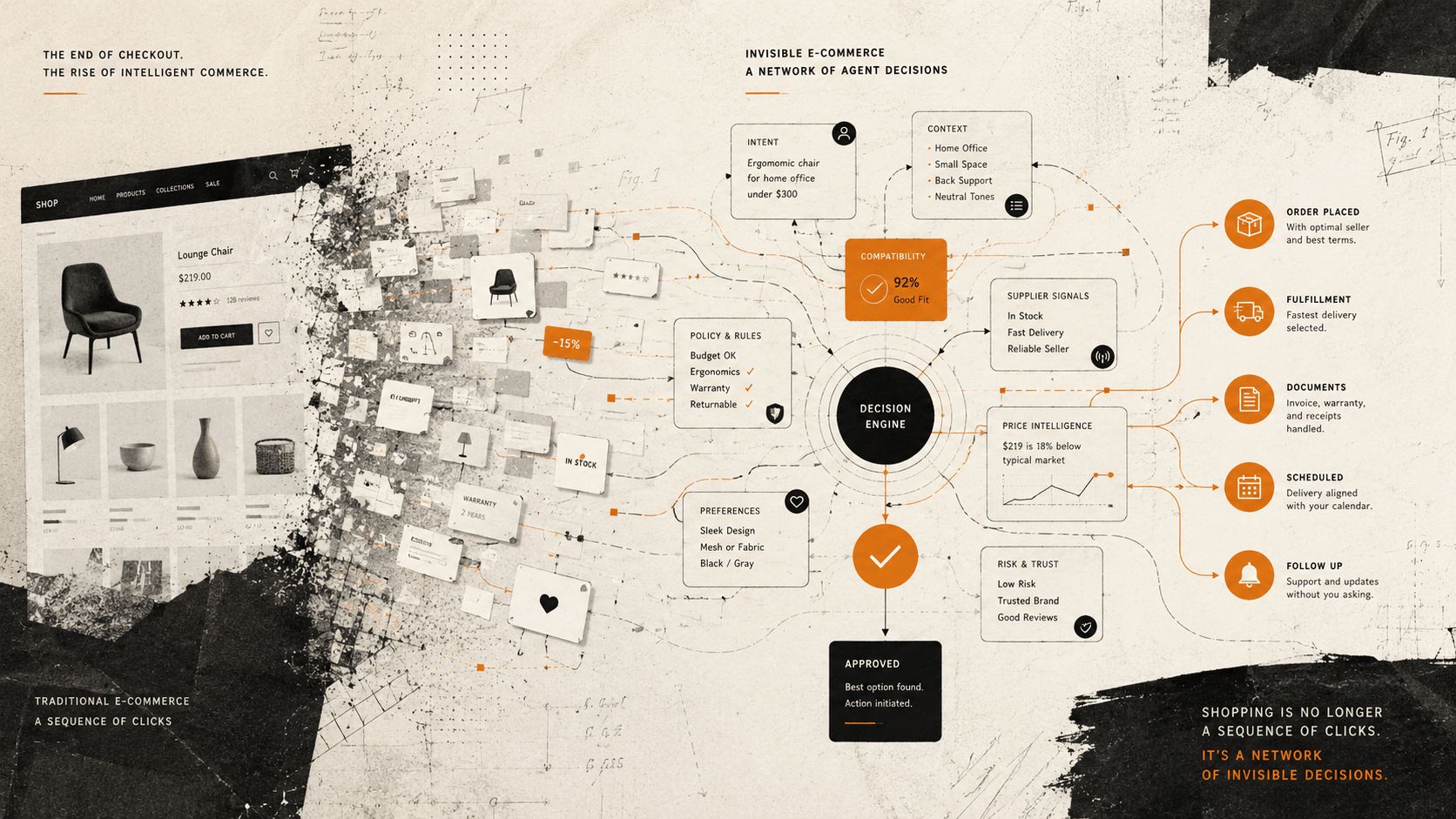
The era of invisible commerce
Perhaps the biggest long-term impact may come from Google's e-commerce announcements.
Google introduced:
- the Universal Commerce Protocol (UCP),
- and the Agent Payments Protocol (AP2).
This points toward a future where commerce increasingly happens between agents rather than through traditional user interfaces.
Users simply define preferences:
- brands,
- budgets,
- quality expectations,
- delivery preferences,
- sustainability requirements.
The agent then:
- searches,
- compares,
- decides,
- pays,
- and completes the transaction.
if agents increasingly shop on our behalf, how does product experience design change?
The next platform shift has already begun
One of the most important lessons from Google I/O 2026 is that AI is no longer just a feature.
It is infrastructure.
Agents are gradually becoming as fundamental to the digital ecosystem as:
- smartphones,
- browsers,
- and cloud platforms once were.
The next platform shift is not about mobile anymore.
It is about agents.
Studio Kuti - Human-centered UX, AI and digital product strategy.
More writing from the archive
Tool Access Is Not Interaction Agreement
Agent tools can authorize and verify every step while still delivering the wrong outcome. The missing layer is an agreement about what done means.
WebMCP and the New Language of the Invisible Web
WebMCP means digital products must be designed not only for humans, but also for AI agents that need to read and act on them.
Projects connected to this thinking
Raiffeisen Bank: End-to-End Online Account Opening
Raiffeisen Bank: End to End Online Account Opening When Raiffeisen Bank decided to let customers open a bank account entirely online — no branch visit required — they kne…
Open Brain: Building a Personal Knowledge Backend with AI
Open Brain: Building a Personal Knowledge Backend with AI What if your notes could think? Not in a sci fi way — but in a practical, "I wrote something three months ago th…